
Last updated June 22, 2026
The Complete Guide to Garage Door in Fort Lauderdale
Fort Lauderdale sits inside one of only two High-Velocity Hurricane Zones (HVHZ) in the entire United States — and that single fact changes almost every decision you’ll make about your garage door. A door that passes code in Tampa, Orlando, or anywhere outside South Florida can be rejected on inspection here the same afternoon it’s installed. Add relentless salt air off the Atlantic, year-round humidity that hovers above 70%, and a permitting process stricter than most homeowners expect, and you’re looking at a purchase that demands local knowledge, not a generic buying guide. This page gives Fort Lauderdale homeowners a region-specific framework — covering codes, materials, costs, and maintenance — so you buy the right door the first time.
Quick Answer
Choosing, installing, and maintaining a garage door in Fort Lauderdale requires HVHZ-compliant, impact-rated products backed by a valid Florida Product Approval (FPA) number — standard doors sold at most big-box chains do not qualify. Expect total installed costs to run higher than national averages due to local permitting requirements and the premium on impact-rated materials. A licensed contractor who knows Broward County code will save you more money than a discounted door ever could.
Table of Contents
- What HVHZ Means for Your Garage Door
- How to Read and Verify a Florida Product Approval Number
- Material Comparison for Fort Lauderdale’s Coastal Climate
- Real Cost Breakdown for Fort Lauderdale
- Installation: What the Process Actually Looks Like Here
- Choosing the Right Garage Door Opener for South Florida
- Maintenance Schedule for a Coastal Garage Door
- Repair vs. Replace: How to Make the Right Call
What HVHZ Means for Your Garage Door
The High-Velocity Hurricane Zone designation covers Miami-Dade and Broward Counties — and Fort Lauderdale sits squarely inside it. The Florida Building Code’s HVHZ provisions require that every garage door installed in this zone be tested to withstand wind loads that would be extraordinary anywhere else in the country. We’re talking about design pressure ratings that routinely exceed 70 pounds per square foot for larger openings.
What does that mean practically? The vast majority of garage doors sold at Home Depot, Lowe’s, and warehouse clubs are not HVHZ-approved. They may be marketed as “hurricane-resistant” or “wind-rated,” but without a product approval specifically covering Broward County’s wind speed requirements, they cannot legally be installed here. Some builders try to work around this with horizontal bracing kits — those don’t fly in Fort Lauderdale either unless the kit itself carries its own FPA number.
“Impact-rated” on a spec sheet should point you to a specific design pressure number and a corresponding Florida Product Approval. If a salesperson can’t give you both, the door isn’t right for this market.
- Design Pressure (DP) rating: The numeric value (e.g., DP +40/-40) that describes how much positive and negative wind load the door is tested to handle.
- Florida Product Approval (FPA) number: A state-issued identifier you can verify online at the Florida Department of Business and Professional Regulation site.
- Wind-Borne Debris Region: All of Broward County qualifies, which adds an additional layer of glazing and reinforcement requirements for any glass sections in a door.
Richard Anderson has pulled permits in Broward County for over a decade and has seen first-hand how often non-compliant doors get flagged — more on that in the common mistakes section below.
How to Read and Verify a Florida Product Approval Number
Every garage door manufacturer that sells into the HVHZ market must register their product with the Florida Building Commission. That registration produces an FPA number in the format FL XXXXX — for example, FL 10245. Before you purchase any door for a Fort Lauderdale property, you should verify that number yourself. Here’s how:
- Get the FPA number from the manufacturer or dealer before any money changes hands. It should appear on the product spec sheet, not just in a sales brochure.
- Go to the Florida Building Code Product Approval Search at floridabuilding.org and enter the FL number in the search field.
- Check the approval scope. The listing will show the specific opening sizes, design pressure ratings, and installation configurations the approval covers. A door approved for a 9×7 opening isn’t automatically approved for a 16×7 opening — the DP math changes with the square footage.
- Confirm the approval hasn’t expired. FPA numbers can lapse. If the listing shows an expiration date that has passed, the door is not currently approvable for installation in Fort Lauderdale without a re-evaluation.
- Match the installation method to the approval. The FPA listing specifies header and jamb attachment details. If the installer deviates from those details, the door may not pass inspection even if the product itself is approved.
Brands like Clopay, Amarr, Wayne Dalton, and Raynor all maintain current FPA listings for their HVHZ product lines. When Richard sources doors for Fort Lauderdale installations, the FPA number is the first filter — not style, not price.
Material Comparison for Fort Lauderdale’s Coastal Climate
National buying guides usually reduce material choice to aesthetics and budget. In Fort Lauderdale, the salt-air environment off the Intracoastal and Atlantic adds a corrosion variable that changes the math significantly — especially for homes east of Federal Highway or near the barrier island communities.
Steel
Steel doors are the most common choice and cover the widest range of HVHZ-rated products. The critical spec for coastal Fort Lauderdale is the gauge and the finish system. Twenty-five gauge steel with a galvanized substrate and a factory-applied polyester or Kynar coating holds up well even a few blocks from the water. Thinner, uncoated steel — common in budget doors — shows surface rust within two to three seasons in neighborhoods like Victoria Park or Rio Vista, where the salt load in the air is measurably higher than inland areas like Tamarac.
Aluminum
Aluminum is naturally rust-proof, which makes it appealing for waterfront properties. The tradeoff is stiffness: aluminum panels dent more easily than steel, and achieving the design pressure ratings required under HVHZ generally demands heavier-gauge frames and additional reinforcement, which pushes the price up. For a home on the Las Olas Isles or on one of Fort Lauderdale’s finger islands, aluminum with a heavy-wall extrusion is worth the premium.
Fiberglass and Composite
Fiberglass won’t rust and handles humidity well, but the available selection of HVHZ-rated fiberglass doors is narrow. Wayne Dalton makes one of the better composite options in this category. The bigger concern in Fort Lauderdale is long-term UV degradation — fiberglass panels can chalk and fade under sustained South Florida sun faster than a quality steel finish system.
Wood
Real wood garage doors are rarely the right call in Fort Lauderdale’s climate. Humidity cycling causes wood panels to swell, warp, and eventually delaminate, and the maintenance burden — stripping, resealing, repainting — is ongoing. We see wood doors mostly on older Coral Ridge or Harbor Beach homes where the architectural character of the neighborhood makes them desirable, but even there, the owners are repainting every two to three years.
Real Cost Breakdown for Fort Lauderdale
Garage door costs in Fort Lauderdale run higher than the national averages most websites quote — for reasons that are entirely predictable once you understand the local market. Here’s an honest breakdown:
| Cost Component | Typical Range (Fort Lauderdale) |
|---|---|
| HVHZ-rated steel door (single, 9×7) | $850 – $1,400 |
| HVHZ-rated steel door (double, 16×7) | $1,400 – $2,800 |
| Aluminum door (double, waterfront spec) | $2,200 – $4,500+ |
| Opener installation (standard) | $250 – $450 |
| Broward County permit fee | $150 – $350 |
| Labor (installation, standard opening) | $300 – $600 |
| Spring replacement (torsion, pair) | $180 – $320 |
| Panel replacement (single panel) | $250 – $500 |
The permit line item is something many Fort Lauderdale homeowners don’t budget for. Broward County requires a permit for any new garage door installation — not just replacements on new construction. Skipping the permit to save a few hundred dollars can cost you far more when the work shows up as unpermitted during a home sale inspection. Richard pulls permits on every installation he does in Fort Lauderdale, and that’s not negotiable.
Labor costs here also reflect the HVHZ installation requirements: the header attachment details, the anchor bolt spacing, and the wind-load certification paperwork add time to every job that a standard installation in another state wouldn’t carry.
Installation: What the Process Actually Looks Like Here
A by-the-book garage door installation in Fort Lauderdale involves more steps than most homeowners realize going in. Here’s what a compliant installation sequence looks like:
- Pre-installation measurement and opening assessment. The rough opening dimensions, header height, and side room determine which FPA-approved products will fit. This isn’t just tape-measure work — the header material (wood vs. concrete block) affects the anchor attachment method required under the FPA listing.
- Permit application to Broward County. The application requires the FPA number, product spec sheets, and the installing contractor’s license information. Turnaround on residential permits is typically a few business days, though it can vary.
- Removal of the existing door. If the old door was installed without a permit, or if there’s existing damage to the framing, that needs to be documented and addressed before the new door goes in.
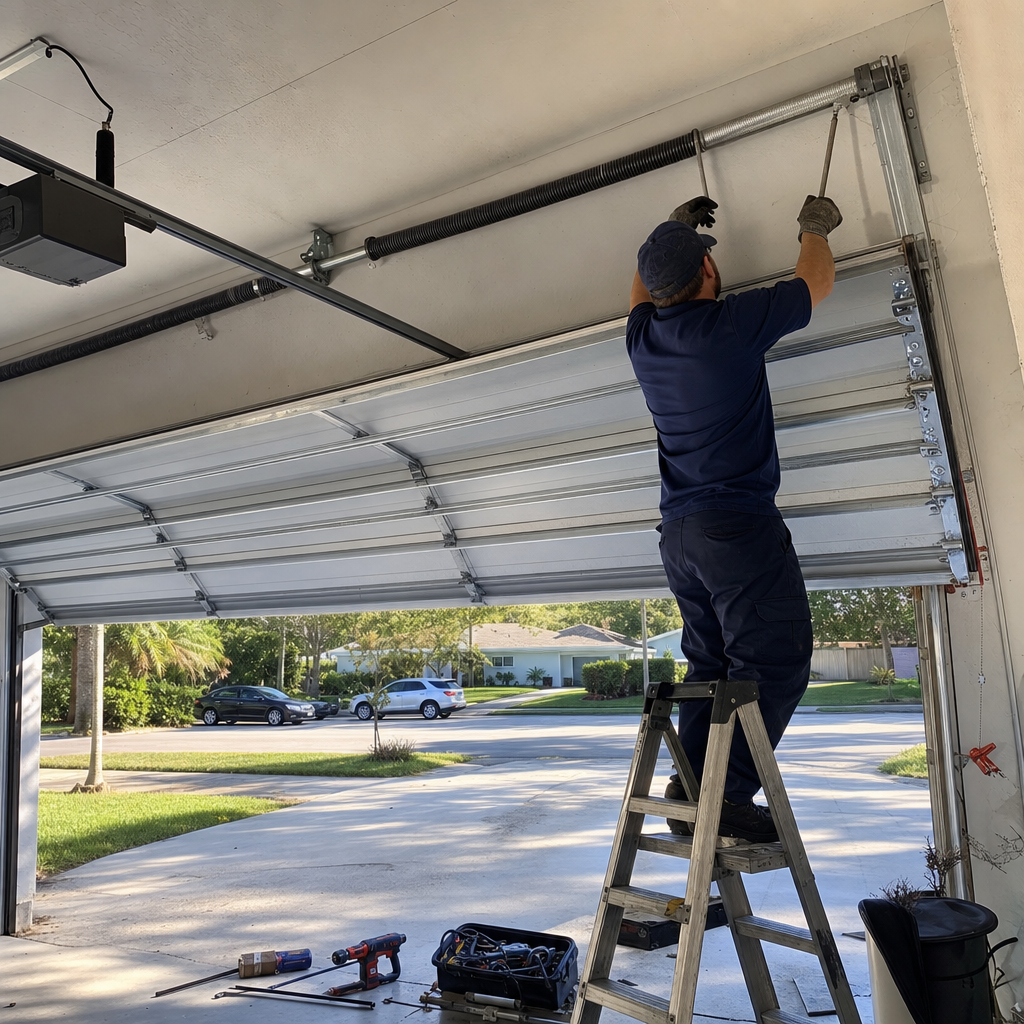
- Track and spring installation per manufacturer specs. The spring tension, track gauge, and horizontal track pitch are all specified in the FPA installation documents. Deviation here is one of the most common reasons doors fail their first inspection.
- Panel installation and hardware attachment. Panels go in from the bottom up. All hinge and roller hardware must match the approved hardware listed in the FPA submission.
- Opener rough-in and final connection. If a new opener is going in simultaneously, this is when the operator rail, trolley, and wall button wiring get run.
- Inspection by Broward County. The inspector verifies the installed product against the permit application and the FPA listing. A failed inspection typically means the door needs to be partially disassembled for re-examination.
- Permit closeout. Once inspection passes, the permit is closed and the record is attached to the property.
For Garage Door Installation in Lauderhill and across the Fort Lauderdale metro, Richard personally manages every step of this sequence — not a subcontractor who may or may not be familiar with Broward County’s specific inspection process.
Choosing the Right Garage Door Opener for South Florida
The opener choice matters more in Fort Lauderdale than a lot of buyers expect, and the reasons are specific to the local environment. Heat, humidity, and the weight demands of HVHZ-rated doors all factor in.
HVHZ-rated doors are heavier than standard doors by design — the reinforcement required to hit the design pressure numbers adds mass. An opener sized for a standard residential door may be underpowered for a properly spec’d Fort Lauderdale door. For a 16×7 double door with a design pressure rating of DP +/-50 or higher, a ¾ HP or 1 HP belt-drive or chain-drive unit is usually the right call. LiftMaster’s 8550W and 87504-267 models, and Chamberlain’s equivalent B4545 series, are the units we install most frequently on heavy HVHZ doors in Fort Lauderdale.
Battery backup is not optional in this market. Fort Lauderdale loses power during every named storm and during many of the afternoon thunderstorms that roll through June through September. LiftMaster and Chamberlain both offer integrated battery backup in their premium lines — it means your door opens when the power is out, which matters when you need to get into the garage before a storm arrives.
For smart home integration, Chamberlain’s myQ platform and LiftMaster’s equivalent give you remote monitoring and control from a phone — genuinely useful when you’re evacuating and want to confirm the garage door is down before you leave town. Genie’s Aladdin Connect system is another solid option, particularly for homes that already run on a different smart home ecosystem.
Craftsman openers, sold through Lowe’s and compatible with many Chamberlain components, are a reasonable mid-tier option for lighter doors. For commercial applications, or for any situation where the door gets heavy daily use, we lean toward LiftMaster’s commercial-grade 3900 series. See our full breakdown of openers on the Garage Door Opener in Lauderhill page.
Maintenance Schedule for a Coastal Garage Door
A garage door in Fort Lauderdale needs more frequent maintenance than the same door installed in, say, Phoenix or Chicago — and the reason is the combination of salt air, humidity, and UV exposure that accelerates wear on every metal component. Here’s the schedule we recommend based on 12 years of field work in this specific climate:
Every 3 Months
- Lubricate springs, hinges, and rollers with a silicone-based or white lithium spray. In coastal Fort Lauderdale neighborhoods — Lauderdale-by-the-Sea, Harbor Beach, Edgewood — do this every six weeks rather than quarterly. Salt air accelerates metal fatigue on torsion springs faster than most homeowners realize until a spring breaks mid-cycle.
- Inspect the bottom seal. Fort Lauderdale’s afternoon rain events are intense and often wind-driven. A cracked or compressed bottom seal lets water sheet under the door and pool on the garage floor. Replace it before it fails completely.
- Wipe down the door exterior with a mild detergent and water to remove salt residue. This is especially important within a half-mile of the Intracoastal or the beach.
Every 6 Months
- Test the auto-reverse mechanism. Place a 2×4 flat on the ground in the door’s path and hit the close button. The door should reverse within two seconds of contact. This is a safety test, not a suggestion.
- Check all hardware for corrosion. Look at hinge bolts, roller stems, and cable anchor brackets. Surface rust on these components in a coastal environment is a precursor to failure, not a cosmetic issue.
- Inspect cables for fraying. Garage door cables under spring tension are dangerous to handle, but you can visually inspect them for frayed strands or kinks. Any fraying means the cable needs replacing before the next full cycle.
Annually
- Full balance test. Disconnect the opener, manually lift the door to waist height, and release it. A properly balanced door holds in place. One that drops or rises on its own has a spring tension problem.
- Check weatherstripping on all four sides. Fort Lauderdale’s hurricane season runs June through November. Degraded weatherstripping lets wind-driven rain in during storms and reduces the door’s effective performance against wind pressure.
- Inspect the door panels for dents, delamination, or paint failure. Small dents in steel panels can compromise the structural integrity that the HVHZ rating depends on in extreme wind events.
See the full range of maintenance and repair services at Garage Door Repair in Lauderhill.
Repair vs. Replace: How to Make the Right Call
This is the question Richard gets asked most often when he’s out on a service call in Fort Lauderdale — and the honest answer depends on three factors: the age of the door, its HVHZ compliance status, and the nature of the damage.
Repair makes sense when:
- The door is under 10 years old, the panels are structurally sound, and the problem is mechanical (springs, cables, rollers, opener).
- A single panel is damaged but the rest of the door is in good shape — panel replacement is cost-effective as long as the manufacturer still produces matching panels.
- The opener fails on a door that is otherwise HVHZ-compliant and in good structural condition.
Replacement makes more sense when:
- The door was installed before 2002 (when current HVHZ provisions took effect) and has never been replaced. These doors don’t carry FPA numbers and are technically non-compliant — a problem during any insurance claim after storm damage.
- Multiple panels are damaged or the door has visible corrosion through the steel substrate, not just surface rust.
- The door doesn’t have a valid FPA number and you’re preparing to sell. Buyers’ inspectors in Fort Lauderdale flag non-compliant garage doors consistently, and it almost always becomes a negotiation point.
- Repair costs exceed 50–60% of the replacement cost. At that threshold, a new HVHZ-rated door with a full warranty is the better financial decision.
Richard’s field observation, repeated across dozens of Broward County homes: the most common reason a homeowner ends up replacing a door they thought only needed repair is discovering mid-job that the door was never properly permitted in the first place. When there’s no permit on file, Broward County can require the entire installation to be brought up to current code — which means a current HVHZ-compliant door, installed and permitted fresh.
Common Mistakes to Avoid
- Buying a door without confirming the FPA number first. Several Fort Lauderdale homeowners have purchased doors from out-of-state suppliers that are “hurricane-rated” but don’t carry a current Florida Product Approval for Broward County. The door fails inspection, and the return process — if one is even available — is painful and expensive.
- Skipping the permit to save time and money. Unpermitted work shows up in public records searches during real estate transactions in Fort Lauderdale, and Broward County’s inspection process on garage doors is not a formality. The fine for unpermitted work and the cost of bringing it up to code after the fact far exceed the permit fee.
- Installing a standard opener on a heavy HVHZ door. Impact-rated doors are heavier. A ½ HP opener that would be adequate for a standard door will struggle, overheat, and fail prematurely on a door rated to DP +/-50 or higher.
- Ignoring salt-air corrosion on hardware. In neighborhoods east of Federal Highway in Fort Lauderdale, torsion spring failure rates are noticeably higher than in inland areas. The spring itself looks fine until it doesn’t — regular lubrication and inspection is the only way to stay ahead of it.
- Using non-approved hardware during a DIY installation. The FPA listing for a door specifies the exact hinges, rollers, and brackets that were tested with that door. Substituting “equivalent” hardware from a hardware store voids the approval and can trigger a failed inspection.
- Assuming “wind-resistant” labeling equals HVHZ compliance. Marketing language on packaging is not code compliance. The only thing that matters in Fort Lauderdale is the FL number and Broward County’s wind load maps.
- Waiting too long to replace a worn bottom seal before hurricane season. June arrives fast, and a $40 seal replacement done in April beats a waterlogged garage floor in July. Richard sees this every year in Fort Lauderdale — deferred maintenance on seals and weatherstripping that becomes a problem the first real storm of the season.
When to Call a Professional
Some garage door work is genuinely DIY-friendly — lubricating hardware, replacing a bottom seal, reprogramming a keypad. A lot of it isn’t, and in Fort Lauderdale the threshold for calling a professional is lower than in other markets because the HVHZ code requirements mean even routine-seeming work can have permit implications.
Call a professional immediately if:
- A torsion spring has broken. These springs are under hundreds of pounds of torque and will cause serious injury if mishandled.
- A cable has snapped or come off the drum — the door is now unbalanced and potentially dangerous to operate.
- The door is off its tracks or binding in the tracks.
- You’re replacing a door or installing a new opener and need a permit pulled.
- The door took damage in a storm and you’re not certain the structural integrity of the panels is intact.
Liberty Bell Garage Door Service Lauderhill offers free estimates in Fort Lauderdale and throughout Broward County. Call Richard directly at (561) 562-7368 — for both planned work and situations that can’t wait.
Frequently Asked Questions
Yes — Broward County requires a permit for every new garage door installation, including replacements. The permit process ties the installation to a specific FPA-approved product and triggers an inspection that verifies HVHZ compliance. Skipping this step creates a code violation record that will surface during any future home sale. Call (561) 562-7368 and we’ll handle the permit process for you.
A complete garage door installation in Fort Lauderdale — HVHZ-rated door, professional installation, permit, and opener — typically runs between $1,800 and $4,000 for a standard double-car opening, depending on the door material and design pressure rating required. Aluminum doors for waterfront properties can push higher. Those numbers are above national averages because HVHZ-rated products and Broward County permitting both add real cost. Call (561) 562-7368 for a free, no-obligation estimate specific to your home.
“Hurricane-rated” is a marketing term with no legal definition in Florida building code. HVHZ compliance means the door carries a current Florida Product Approval number that specifically covers Broward County’s wind speed requirements and design pressure zones. Always ask for the FL number — not a brochure claim.
Standard torsion springs are rated for roughly 10,000 cycles — which translates to seven to nine years of typical residential use. In coastal Fort Lauderdale, particularly in neighborhoods within a mile of the ocean or Intracoastal, salt-air corrosion can cut that lifespan to five to seven years even with regular lubrication. We see spring failures in Lauderdale-by-the-Sea and Harbor Beach properties more frequently than in inland Broward zip codes for exactly this reason. When one spring breaks, we typically recommend replacing both — the second one is usually close behind.
Legally, a homeowner can pull a permit and install their own door on their primary residence. Practically, the FPA-specified installation details — anchor bolt spacing, header attachment method, specific hardware — are technical enough that errors routinely result in failed inspections. Richard’s field observation from a decade of Broward County work: the single most common reason DIY-installed doors fail their first inspection is that the installer used the hardware that came in the box rather than confirming it matched the specific hardware listed in the FPA approval documentation. The savings rarely hold up after re-inspection fees and the cost of partial disassembly.
Clopay, Amarr, and Wayne Dalton all maintain strong current FPA listings for their HVHZ product lines and are the brands we install most frequently in Fort Lauderdale. Raynor is another solid option with good corrosion-resistance finishes in their coastal product tiers. Whatever brand you have — including LiftMaster, Chamberlain, Genie, or Craftsman on the opener side — Richard is factory-trained on all eight and carries parts for the brands he services.
The Bottom Line
A garage door in Fort Lauderdale is not a standard home improvement purchase — it’s a code-compliance decision made in one of the most demanding building environments in the country. The HVHZ designation, Florida Product Approval requirements, Broward County permit process, and salt-air material demands all point to the same conclusion: the door, the hardware, the installation method, and the installer all have to be right. Cutting corners on any one of them creates a problem that costs more to fix than doing it correctly the first time. Start with the FPA number, match the material to your specific location in Fort Lauderdale, budget for the permit, and work with someone who knows this market by name — not by zip code.
Written by Richard Anderson, Owner & Lead Technician at Liberty Bell Garage Door Service Lauderhill, serving Fort Lauderdale since 2014. 12 years of field experience, 111 verified reviews, 4.9-star average rating.